· Updated
By C² Tides
FDA Advisory Committee Recommends Easing Restrictions on Six Peptides: What It Actually Means
In July 2026, an FDA advisory committee recommended allowing compounding pharmacies to prepare six specific peptides. Here’s a clear breakdown of what the vote means and what it does not mean.
In July 2026, an important regulatory development brought several widely discussed peptides back into the spotlight.
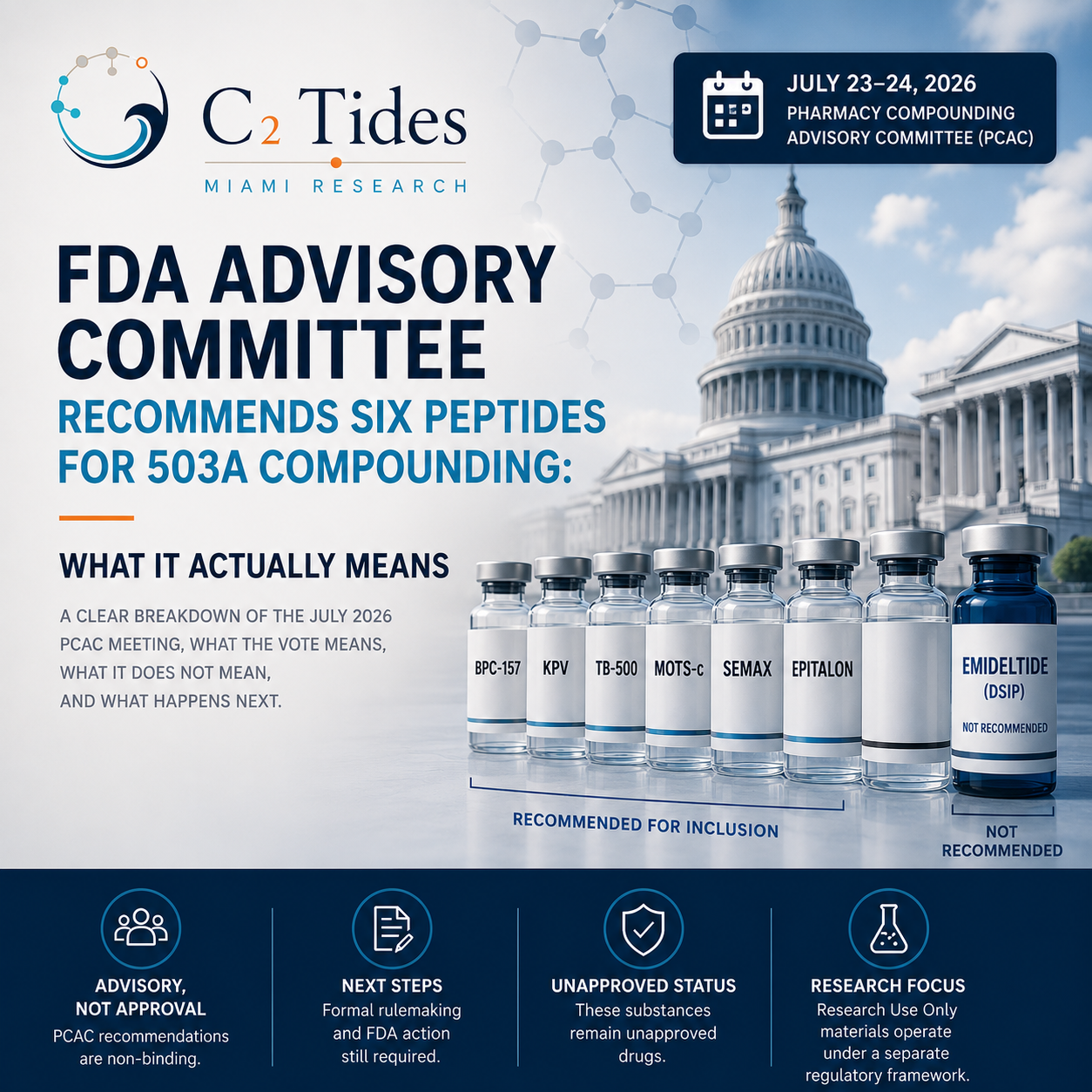
On July 23–24, the U.S. Food and Drug Administration’s Pharmacy Compounding Advisory Committee (PCAC) met to evaluate seven peptide-related bulk drug substances being considered for potential inclusion on the Section 503A Bulks List.
The committee ultimately recommended six:
- BPC-157
- KPV
- TB-500
- MOTS-c
- Semax
- Epitalon
The committee did not recommend Emideltide, also known as delta sleep-inducing peptide (DSIP).
This was a meaningful regulatory development — but it was not FDA approval.
The committee’s recommendations are advisory and non-binding. They do not establish that these peptides are FDA-approved medications, and they do not automatically authorize pharmacies to begin compounding them under Section 503A.
Understanding that distinction is essential.
What Is the Pharmacy Compounding Advisory Committee?
The Pharmacy Compounding Advisory Committee (PCAC) provides independent expert advice to the FDA on scientific, technical, and medical issues involving drug compounding.
The committee reviews available evidence and makes recommendations to the agency.
FDA retains final regulatory authority.
An advisory committee recommendation should therefore not be confused with FDA approval or a final regulatory decision.
What Exactly Did FDA Evaluate?
The July meeting was not simply a vote on whether each peptide was “safe” or “effective.”
FDA evaluated specific bulk drug substances in connection with particular nominated uses.
### BPC-157
Evaluated in connection with ulcerative colitis.
### KPV
Evaluated in connection with wound healing and inflammatory conditions.
### TB-500
Evaluated in connection with wound healing.
### MOTS-c
Evaluated in connection with obesity and osteoporosis.
### Semax
Evaluated in connection with cerebral ischemia, migraine, and trigeminal neuralgia.
### Epitalon
Evaluated in connection with insomnia.
### Emideltide (DSIP)
Evaluated in connection with opioid withdrawal, chronic insomnia, and narcolepsy.
The fact that FDA evaluated these nominated uses does not mean FDA approved, endorsed, or validated those uses.
This distinction is especially important because many of these substances are discussed online for purposes far beyond the uses considered during the PCAC meeting.
What Did the Committee Recommend?
After reviewing the available information, PCAC recommended six peptide-related bulk drug substances for potential inclusion on the 503A Bulks List:
Recommended for inclusion
- BPC-157
- KPV
- TB-500
- MOTS-c
- Semax
- Epitalon
Not recommended
- Emideltide (DSIP)
The recommendations represent an important step in the regulatory process, but they are not the final step.
What Is Section 503A?
Section 503A of the Federal Food, Drug, and Cosmetic Act establishes a framework under which qualifying licensed pharmacists and physicians may compound medications for identified individual patients when applicable statutory requirements are satisfied.
One component of that framework involves the bulk drug substances that may be used for compounding.
For certain substances that are not components of FDA-approved drugs and do not have an applicable USP or National Formulary monograph, inclusion on the 503A Bulks List can provide a pathway for their use in qualifying compounded preparations.
Being eligible for 503A compounding is not the same as becoming an FDA-approved drug.
Compounded drugs generally do not undergo FDA’s standard premarket approval process for safety, effectiveness, and manufacturing quality.
Why Were These Peptides Under Regulatory Scrutiny?
The committee’s recommendations should not be interpreted as meaning that all previous FDA concerns surrounding these substances have disappeared.
FDA has previously identified potential concerns involving certain peptide-related bulk drug substances, including:
- Limited human safety information
- Potential immunogenicity
- Peptide aggregation
- Peptide-related impurities
- Active pharmaceutical ingredient characterization
- Limited information regarding particular routes of administration
The amount and quality of available human evidence also varies substantially between substances.
For example, FDA has previously stated that it had not identified human exposure data for certain substances such as KPV and MOTS-c.
These unanswered questions remain relevant when interpreting the committee’s recommendations.
Recommendation Does Not Mean FDA Approval
This is the most important takeaway from the July meeting.
Statements such as:
“FDA approved BPC-157.”
or
“FDA legalized six peptides.”
do not accurately describe what occurred.
A more accurate description is:
An FDA advisory committee recommended six peptide-related bulk drug substances for potential inclusion on the Section 503A Bulks List.
FDA itself explains that advisory committee recommendations are non-binding.
The agency considers those recommendations along with the underlying scientific evidence and other relevant information before making final regulatory decisions.
What Happens Next?
The next step belongs to FDA.
The agency must consider the committee’s recommendations and determine whether to proceed with the formal regulatory process necessary to add any of these substances to the 503A Bulks List.
That process can involve:
1. FDA review of the committee’s recommendations and supporting evidence.
2. Publication of a proposed rule.
3. A public comment period.
4. FDA review of submitted comments and additional information.
5. Publication of a final rule if FDA decides to proceed.
There is no guarantee that every recommendation made by PCAC will ultimately become final FDA policy.
There is also no guaranteed timeline for completion of this process.
Until FDA completes the necessary regulatory steps, the advisory committee vote itself should not be treated as a change in federal approval status.
What Would 503A Inclusion Actually Mean?
If FDA ultimately adds one or more of these substances to the 503A Bulks List, that still would not make the substance an FDA-approved medication.
Instead, under qualifying circumstances, eligible state-licensed pharmacists or physicians operating under Section 503A could potentially use an eligible bulk drug substance to prepare a compounded medication for an identified individual patient when the applicable legal requirements are satisfied.
Bulk drug substances used in qualifying compounding are also subject to requirements involving areas such as sourcing and Certificates of Analysis.
This is fundamentally different from FDA approving a finished pharmaceutical drug for widespread commercial distribution.
Research Use Only Materials Are Different
Another important distinction involves Research Use Only (RUO) materials.
Materials genuinely intended exclusively for laboratory or scientific research operate in a different context from patient-specific medications prepared by licensed compounding pharmacies.
The July PCAC meeting concerned the 503A pharmacy-compounding framework.
It did not convert Research Use Only products into medications or authorize RUO suppliers to market products for human use.
Additionally, simply placing “Research Use Only” on a label does not by itself determine a product’s regulatory status. How a product is represented, marketed, distributed, and intended to be used can also matter.
Keeping these categories separate is essential for researchers, suppliers, healthcare professionals, and consumers trying to understand this regulatory development.
Why This Vote Still Matters
With all of those qualifications, the July 2026 meeting remains noteworthy.
Six peptide-related substances that have generated considerable scientific and regulatory discussion received majority support from an FDA advisory committee for potential inclusion within a pharmacy-compounding pathway.
That does not establish clinical efficacy.
It does not eliminate unresolved safety questions.
It does not constitute FDA approval.
But it does demonstrate that the regulatory conversation surrounding these substances continues to evolve.
The responsible approach is neither to exaggerate the committee’s decision nor to dismiss it.
It is to understand precisely what happened and follow what FDA does next.
Quality, Testing, and Regulatory Status Are Different Questions
Regulatory status is only one part of understanding research materials.
Reliable laboratory research also depends on understanding the characteristics of the material being studied.
Useful analytical documentation can include information concerning:
- Identity
- Purity
- Batch or lot traceability
- Analytical methodology
- Storage conditions
- Certificates of Analysis
- Independent laboratory testing, where applicable
However, these concepts should not be confused.
A Certificate of Analysis does not make an investigational substance FDA-approved.
Likewise, a reported high purity percentage does not establish that a substance is safe or effective for human use.
Analytical testing can provide information about the material being evaluated. Regulatory approval and clinical evidence answer different questions.
At C² Tides, we believe researchers are best served when those distinctions remain clear and information is presented transparently.
Frequently Asked Questions
Did FDA approve BPC-157 in July 2026?
No.
The Pharmacy Compounding Advisory Committee recommended BPC-157-related bulk drug substances for potential inclusion on the 503A Bulks List.
An advisory committee recommendation is not FDA drug approval.
Are BPC-157 and TB-500 now FDA-approved medications?
No.
The July proceedings concerned potential eligibility of certain bulk drug substances for qualifying compounding under Section 503A, not approval of finished drug products.
Can pharmacies automatically begin compounding all six because of the vote?
No.
The advisory committee provides recommendations to FDA. Additional agency action is necessary before those recommendations become part of the applicable regulatory framework.
Does inclusion on the 503A Bulks List mean FDA has proven a substance safe and effective?
No.
Eligibility for qualifying pharmacy compounding and FDA approval of a new drug are separate regulatory concepts.
Did FDA evaluate every claim made about these peptides?
No.
FDA identified specific nominated uses for consideration during the July meeting. Other claims made about these substances should not be interpreted as having been reviewed or endorsed by FDA simply because the peptide appeared before PCAC.
Bottom Line
The July 23–24, 2026 Pharmacy Compounding Advisory Committee meeting represents an important development in the U.S. regulatory discussion surrounding several peptides.
The committee recommended:
BPC-157, KPV, TB-500, MOTS-c, Semax, and Epitalon
for potential inclusion on the Section 503A Bulks List.
Emideltide (DSIP) was not recommended.
But the most important word is recommended.
The committee’s recommendations are advisory and non-binding. They are not FDA drug approvals, do not establish clinical safety or effectiveness, and do not by themselves authorize general commercial sale or human use.
The next meaningful regulatory developments will come from FDA itself.
Until then, researchers and other interested parties should distinguish between what has actually occurred and speculation about what may happen next.
At C² Tides, we will continue following official FDA information and updating our educational resources as meaningful regulatory developments occur.
Related C² Tides Education
- How to Read a Peptide COA: Purity
- Peptide Storage & Stability for Research
- Not FDA-Approved: Why Those Three Words Don’t Mean What Most People Think
---
Educational Disclaimer
This article is provided for educational and laboratory-research information only. It summarizes publicly available regulatory information and does not constitute medical, legal, pharmaceutical, or regulatory advice.
References to substances discussed by FDA or PCAC should not be interpreted as endorsements of their safety, effectiveness, or suitability for human use. Materials offered by C² Tides as Research Use Only are not intended for human or veterinary use. Readers should consult current FDA publications and qualified professionals for current regulatory, legal, or healthcare guidance.