
· Updated
By C² Tides
Not FDA-Approved: Why Those Three Words Don’t Mean What Most People Think
Creatine, protein powder and countless supplements aren't FDA-approved before reaching consumers. So why does “not FDA-approved” dominate the conversation around peptides? We break down what the term actually means—and the important regulatory differences.
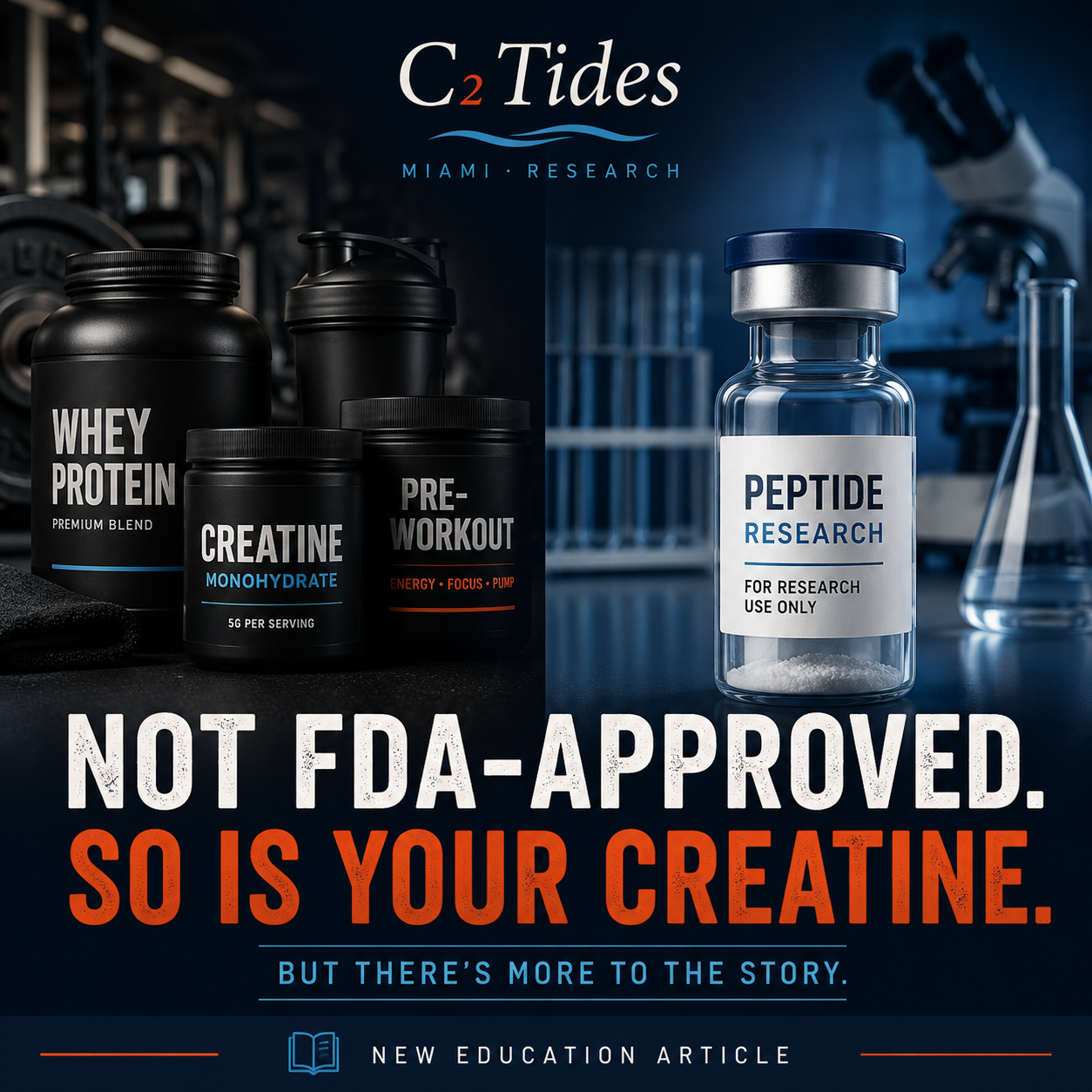
Your Creatine Isn't FDA-Approved Either
Walk into almost any gym in America and you'll see protein powder, creatine, pre-workout, electrolytes and supplements everywhere.
But here's something many consumers don't realize:
The FDA does not approve dietary supplements before they reach the market
So why do the words “NOT FDA-APPROVED” suddenly become the center of the conversation whenever peptides are mentioned?
Creatine? Not FDA-approved as an individual dietary supplement product.
Protein powder? Same story.
Most pre-workouts? Same.
Many vitamins and nutritional supplements? Same.
And yet when the conversation turns to experimental peptides, three words suddenly dominate the discussion:
“Not FDA-approved.”
That raises an important question.
If FDA approval isn't required for many products people willingly consume every day, what does “not FDA-approved” actually tell us?
The answer is more complicated than either side of the peptide debate sometimes makes it sound.
FDA-Regulated Is Not the Same as FDA-Approved
One of the biggest misconceptions surrounding the FDA is the idea that everything sold in America has been individually reviewed and approved by the agency.
It hasn't.
Different categories of products operate under different regulatory frameworks.
Dietary supplements are one example.
Under the Dietary Supplement Health and Education Act of 1994 (DSHEA), dietary supplements generally do not go through FDA premarket approval for safety and effectiveness.
Instead, manufacturers are primarily responsible for ensuring their products are safe, properly manufactured and accurately labeled. The FDA can then inspect facilities, monitor adverse events and take enforcement action against products that are unsafe, adulterated or improperly marketed.
That's very different from the approval process for a new pharmaceutical drug.
And understanding that distinction matters.
Think About What's Already in Your Gym Bag
Consider how normal these products have become:
Protein powder.
Creatine.
Pre-workout.
Amino-acid supplements.
Electrolyte powders.
Multivitamins.
Consumers routinely purchase these products without asking whether the FDA individually reviewed that particular tub, bottle or formulation and determined that it was safe and effective.
That isn't necessarily irresponsible.
It's simply a reflection of how U.S. law regulates dietary supplements.
The FDA itself identifies whey protein and creatine as examples of dietary supplements and explains that supplements are not approved before being sold to consumers.
So “not FDA-approved” cannot automatically mean “illegal,” “dangerous” or “fraudulent.”
If it did, an enormous portion of the supplement aisle would have a serious problem.
Then Why Are Peptides Treated Differently?
This is where the conversation needs nuance.
A peptide sold or promoted for therapeutic use is not automatically equivalent to a scoop of creatine.
Route of administration matters.
Intended use matters.
Pharmacological activity matters.
Dosage matters.
Manufacturing quality matters.
And, most importantly, the regulatory category matters.
A product intended to diagnose, cure, mitigate, treat or prevent disease—or otherwise marketed as a drug—can fall under drug regulations requiring substantially different evidence and oversight.
Injectable products also introduce risks that an ordinary oral dietary supplement may not have, including sterility, contamination, dosing accuracy and immune reactions.
That's why simply saying:
“Creatine isn't FDA-approved either.”
doesn't settle the peptide debate.
But the comparison still exposes something important.
“Not FDA-Approved” Is Often Used Without Context
When consumers hear the phrase “not FDA-approved,” many interpret it as:
“The FDA investigated this product and determined that it is unsafe.”
That is not necessarily what the phrase means.
Sometimes it simply means the product has never gone through the FDA approval process applicable to new drugs.
Those are two very different statements.
Lack of approval is not proof of safety.
But lack of approval, by itself, isn't proof of danger either.
What it often means is that the FDA has not received and reviewed the evidence necessary to establish that a particular drug product is safe and effective for its proposed use.
That distinction deserves to be communicated honestly.
Peptides Deserve Scrutiny But So Does Everything Else
There are legitimate reasons for regulators to scrutinize experimental peptides.
Some have limited human clinical data.
Some have unresolved questions regarding long-term safety.
Injectable peptides can introduce concerns surrounding sterility, purity, potency and immune responses.
The FDA has specifically identified potential safety concerns involving several peptides and has stated that, for some, there isn't enough human safety information to determine whether they may cause harm.
Those concerns shouldn't be ignored.
But scrutiny shouldn't eliminate curiosity.
There is a major difference between saying:
“We don't have enough evidence yet.”
and saying:
“We have evidence that this doesn't work.”
Science advances by investigating that difference.
FDA Approval Is a Standard—Not a Universal Product Label
FDA approval is extremely important when we're discussing pharmaceutical drugs.
It means evidence regarding manufacturing, safety and effectiveness has undergone formal regulatory review for a specific indication.
But consumers should understand that FDA oversight isn't one universal system applied identically to everything they purchase.
Your protein powder isn't regulated like a prescription drug.
Your creatine isn't regulated like a vaccine.
A cosmetic isn't regulated like an injectable medication.
And an experimental peptide shouldn't be described as though it occupies the same regulatory category as a dietary supplement simply because neither carries FDA approval.
The categories matter.
The Better Question
Instead of asking only:
“Is it FDA-approved?”
an informed consumer or researcher should ask more questions:
What regulatory category does this product belong to?
What evidence exists?
Have human studies been conducted?
What do those studies actually show?
What safety questions remain unanswered?
How was the material manufactured?
Has identity, purity and potency been independently verified?
Are the claims being made supported by evidence?
Those questions tell us far more than three words ever could.
Where C² Tides Stands
At C² Tides, we believe the conversation around emerging compounds should be based on evidence, transparency and education—not hype or fear.
FDA approval matters.
So does understanding what FDA approval actually means.
Experimental peptides should not be presented as proven medications when they aren't.
At the same time, “not FDA-approved” shouldn't become a substitute for actually discussing the science.
Consumers deserve context.
Researchers deserve good data.
And emerging science deserves to be evaluated on evidence rather than slogans.
Because the most responsible position isn't blindly accepting every new compound—or blindly rejecting one because its research isn't finished.
It's understanding exactly where the evidence stands today.
Educational content only. This article does not provide medical advice or recommend the purchase, administration or human use of investigational compounds. Regulatory status varies by substance, formulation and intended use.