
· Updated
By C² Tides
How to Read a Peptide COA: Purity
Learn how to read a peptide Certificate of Analysis (COA), understand purity and identity testing, and know what laboratory results can and cannot tell you about a research sample.
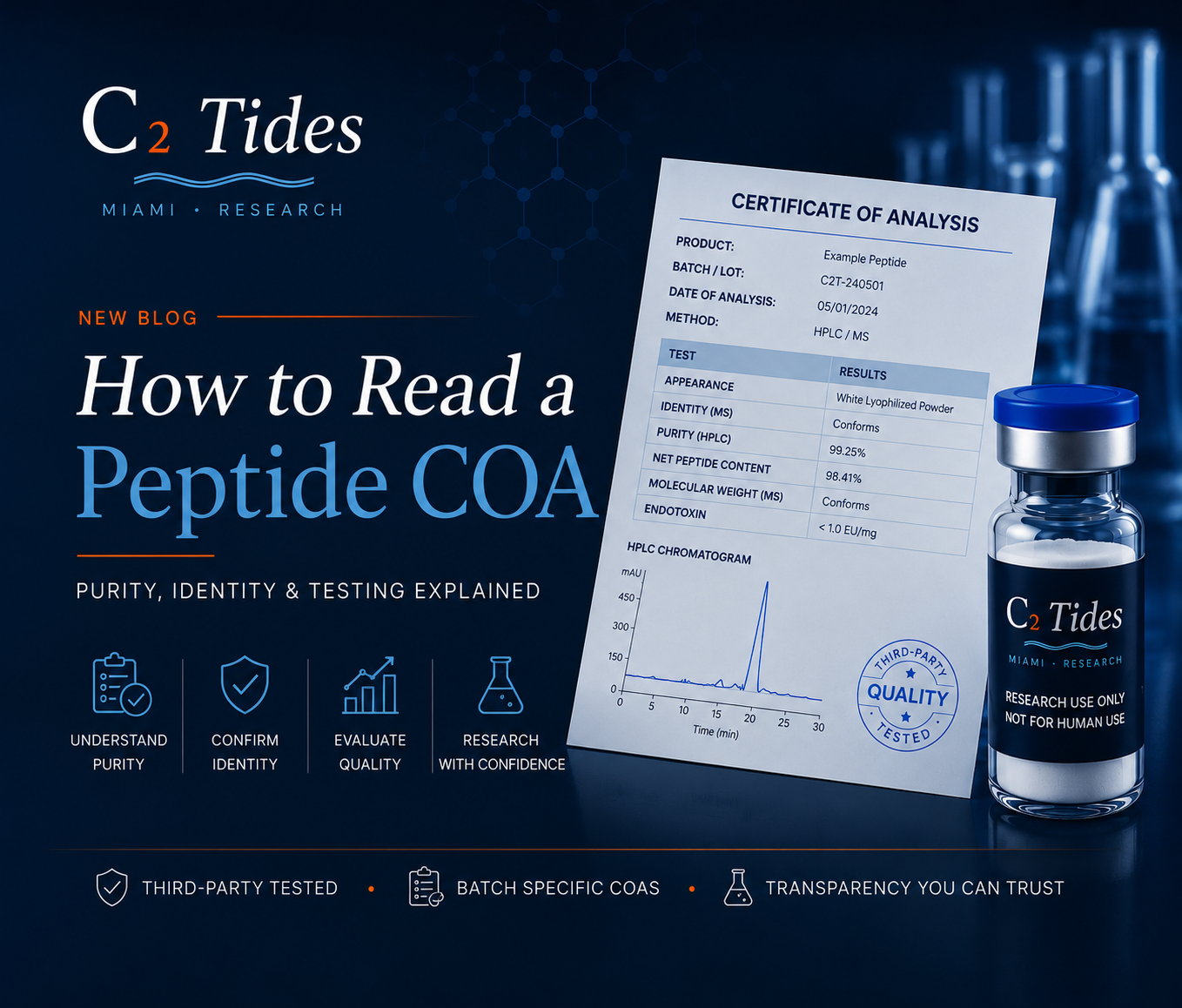
How to Read a Peptide COA: Purity, Identity & Testing Explained
When evaluating a peptide for laboratory research, one of the most important documents to understand is the Certificate of Analysis, commonly called a COA.
A COA provides analytical information about a particular sample or batch. Depending on the laboratory and testing performed, it may include information about identity, purity, quantity, analytical methods, batch identification, and test results.
But simply seeing “99% purity” on a report doesn't tell the whole story.
Understanding what the different measurements actually mean can help researchers evaluate laboratory documentation more carefully.
What Is a Certificate of Analysis (COA)?
A Certificate of Analysis is a document summarizing analytical testing performed on a sample.
A peptide COA may contain information such as:
Compound or sample name
Batch or lot number
Date of testing
Analytical method
Reported purity
Molecular mass or identity information
Chromatograms or spectra
Laboratory information
Additional testing results, when performed
The exact contents of a COA can vary considerably depending on what was tested and which analytical methods were used.
For that reason, researchers should look beyond the final percentage printed on the document and understand what the underlying test actually measured.
Why Are COAs Important in Peptide Research?
Analytical characterization helps researchers understand the material being studied.
Synthetic peptide preparations can potentially contain the intended peptide along with synthesis-related impurities, truncated sequences, residual materials, or other peptide-related compounds.
The FDA has specifically discussed the complexity of peptide characterization and peptide-related impurities in its scientific and regulatory work.
A COA provides researchers with documentation of the analytical testing performed on a particular sample.
However, a COA should be interpreted according to the methods it contains. No single analytical measurement necessarily answers every question about a sample.
What Does Peptide Purity Mean?
This is one of the most commonly misunderstood parts of peptide testing.
When a COA reports something such as:
Purity: 99.2%
that result generally refers to the purity measured using the analytical method listed on the report.
For peptides, one commonly used technique is High-Performance Liquid Chromatography (HPLC).
HPLC separates components of a sample based on how they interact with a chromatography system. The resulting chromatogram displays peaks representing material detected during the analysis.
Researchers can use those peaks to estimate the relative chemical purity of a peptide preparation.
A large primary peak with relatively small additional peaks may indicate that the target material represents a high proportion of the detected sample under those particular analytical conditions.
But there is an important distinction:
Purity does not automatically equal peptide quantity.
A sample reporting 99% chromatographic purity does not necessarily mean that 99% of the total vial weight is the desired peptide.
Those are different measurements.
Purity vs. Net Peptide Content
Understanding this distinction is extremely important when reading peptide laboratory reports.
Purity
Purity generally describes how much of the material detected by a particular analytical method corresponds to the primary peptide compared with detected impurities.
Net Peptide Content
Net peptide content attempts to determine the actual amount of peptide material within the overall sample.
A lyophilized peptide preparation may contain material besides the peptide itself, including water, counterions, salts, or other components associated with manufacturing and formulation.
Therefore:
99% purity ≠ automatically 99% net peptide content
A sample can demonstrate high chromatographic purity while the total amount of peptide present still requires a separate quantitative determination.
This is why researchers should pay attention to exactly what a laboratory report says was measured.
What Is HPLC Testing?
HPLC, or High-Performance Liquid Chromatography, is an analytical technique commonly used to separate and evaluate compounds within a sample.
In simplified terms, a peptide sample moves through a chromatography column.
Different components interact differently with the column and mobile phase, causing them to separate and appear at different times.
The resulting graph is called a chromatogram.
You may see:
A dominant primary peak
Smaller secondary peaks
Retention times
Integrated peak areas
A calculated purity percentage
For peptide analysis, reversed-phase HPLC with UV detection is commonly used to evaluate relative chemical purity.
However, HPLC alone has limitations.
A large chromatographic peak tells researchers that a major component is present, but additional analytical techniques may be necessary to establish that the peak actually corresponds to the intended peptide.
That's where mass spectrometry becomes particularly useful.
What Is Mass Spectrometry?
Mass spectrometry (MS) is an analytical technique that can help characterize a molecule according to its mass-to-charge characteristics.
For peptide research, mass spectrometry can provide important evidence regarding molecular identity.
If a peptide is expected to have a particular molecular mass, researchers can compare experimental mass-spectrometry results with the expected characteristics of the target molecule.
More advanced techniques, including tandem mass spectrometry (MS/MS), can provide additional structural information and can be used to help confirm peptide sequences.
This is why HPLC and mass spectrometry can complement each other.
A simplified way of thinking about them is:
HPLC → How pure does the sample appear under these analytical conditions?
Mass spectrometry → Does the detected material have characteristics consistent with the expected molecule?
Neither should automatically be interpreted as answering every possible quality question.
Why Identity Testing Matters
Imagine receiving a COA showing:
99.7% purity
That sounds impressive.
But there's another question:
99.7% purity of what?
A chromatographic purity result alone does not necessarily establish molecular identity.
Identity testing helps determine whether the analyzed material is consistent with the compound it is claimed to be.
For peptide characterization, techniques involving mass spectrometry and liquid chromatography–mass spectrometry are commonly used alongside chromatographic purity analysis.
Looking at both purity and identity therefore provides substantially more information than looking at a purity percentage alone.
Why Batch Numbers Matter
A useful COA should be associated with a specific batch or lot.
Why?
Because analytical results apply to the material that was actually tested.
If a laboratory analyzes a sample from Batch ABC123, those results document that tested sample or batch—not every batch of that compound that may ever be produced.
Batch-specific documentation improves traceability.
When reviewing a COA, researchers should therefore look for information such as:
Batch or lot number
Sample identification
Testing date
Laboratory name
Analytical methods
Results
The batch information on available documentation should correspond to the material being evaluated whenever applicable.
What Does Third-Party Testing Mean?
Third-party testing means analytical testing is performed by a laboratory that is separate from the supplier or manufacturer providing the research material.
Independent testing can provide an additional layer of verification because the analytical result is being produced by another organization.
However, the phrase “third-party tested” alone is not enough to evaluate quality.
Researchers should still ask:
Which laboratory performed the test?
What sample was tested?
Which analytical method was used?
Is there a batch number?
Can the actual report be reviewed?
Transparency matters more than simply displaying a “third-party tested” badge.
What Can a COA Tell You?
Depending on the testing performed, a COA may provide useful information about:
Identity
Whether analytical results are consistent with the expected compound.
Relative purity
The proportion of detected material attributed to the target compound under a specified analytical method.
Quantity or content
When appropriate quantitative testing has actually been performed.
Batch traceability
Which specific lot or sample was analyzed.
Testing methodology
Which analytical techniques produced the reported results.
Together, these measurements can provide researchers with a more complete analytical picture.
What Can't a COA Tell You?
A COA also has limitations.
For example, an HPLC purity result by itself does not necessarily establish:
Sterility
Endotoxin levels
Net peptide quantity
Long-term stability
Absence of every possible contaminant
Suitability for any particular use
Those questions require appropriate testing designed specifically to measure them.
This is why it is important to read what was actually tested, rather than assuming that one purity number represents every possible quality attribute.
A Simple COA Checklist
When reviewing peptide documentation, consider asking:
1. Is the compound clearly identified?
The report should clearly identify the sample that was submitted for testing.
2. Is there a batch or lot number?
Batch-specific documentation provides better traceability.
3. What analytical method was used?
Look for methods such as HPLC, LC-MS, MS, or other relevant analytical techniques.
4. Is purity reported?
Determine how the laboratory measured that purity.
5. Was identity evaluated?
Look for appropriate identity information rather than relying solely on chromatographic purity.
6. Is quantity actually measured?
Don't assume purity and quantity are interchangeable.
7. Can you see the original laboratory report?
Whenever possible, review the actual analytical documentation rather than relying only on a marketing claim or screenshot.
C₂ Tides and Testing Transparency
At C₂ Tides Miami Research, we believe researchers should be able to review analytical information rather than simply being told that a product was tested.
That's why available batch-specific Certificates of Analysis and third-party laboratory results are made accessible through our website.
Our goal is to make testing information easier to understand while encouraging researchers to look beyond a single purity percentage and evaluate the underlying analytical data.
→ View C₂ Tides Batch COAs
Frequently Asked Questions
Does 99% purity mean a vial contains 99% of the labeled peptide amount?
Not necessarily.
Chromatographic purity and net peptide content are different measurements. A high HPLC purity result describes the relative purity observed under that analytical method; determining actual peptide quantity requires appropriate quantitative analysis.
What does HPLC stand for?
HPLC stands for High-Performance Liquid Chromatography. It is an analytical technique used to separate and evaluate components within a sample.
What does mass spectrometry tell you?
Mass spectrometry analyzes molecular mass-to-charge characteristics and can provide evidence supporting the identity of a peptide. More advanced MS/MS analysis can provide additional structural and sequence information.
Is HPLC enough to identify a peptide?
HPLC provides valuable separation and purity information, but chromatographic purity alone does not necessarily establish molecular identity. Complementary analytical methods such as mass spectrometry can provide additional identity information.
Why should a COA have a batch number?
Analytical results correspond to the sample or batch that was actually tested. A batch number helps connect the laboratory documentation with the specific material being evaluated.
Does a purity test prove sterility?
No. Purity and sterility are different quality attributes and require different analytical or microbiological testing.
The Bottom Line
A peptide COA is much more than the percentage printed at the top of the page.
Understanding purity, identity, quantity, analytical methodology, and batch traceability allows researchers to interpret laboratory documentation more accurately.
Three concepts are especially important to remember:
HPLC can provide information about relative chemical purity.
Mass spectrometry can provide information supporting molecular identity.
Purity and net peptide content are not the same measurement.
Learning to recognize those differences makes a COA considerably more useful than simply looking for “99%.”
Continue Learning
← What Are Peptides? A Beginner's Guide
→ Explore C₂ Tides Batch COAs
https://pmc.ncbi.nlm.nih.gov/articles/PMC4830481/?utm_source=chatgpt.com
https://www.accessdata.fda.gov/scripts/publications/search_result_record.cfm?id=49892&utm_source=chatgpt.com
This article is provided for educational and research information only. It is not medical advice and does not establish that any research compound is approved, safe, effective, sterile, or suitable for human use.