
· Updated
By C² Tides
When Innovation Meets Control: The Retatrutide Debate Over Safety, Access & the Pharmaceutical Market
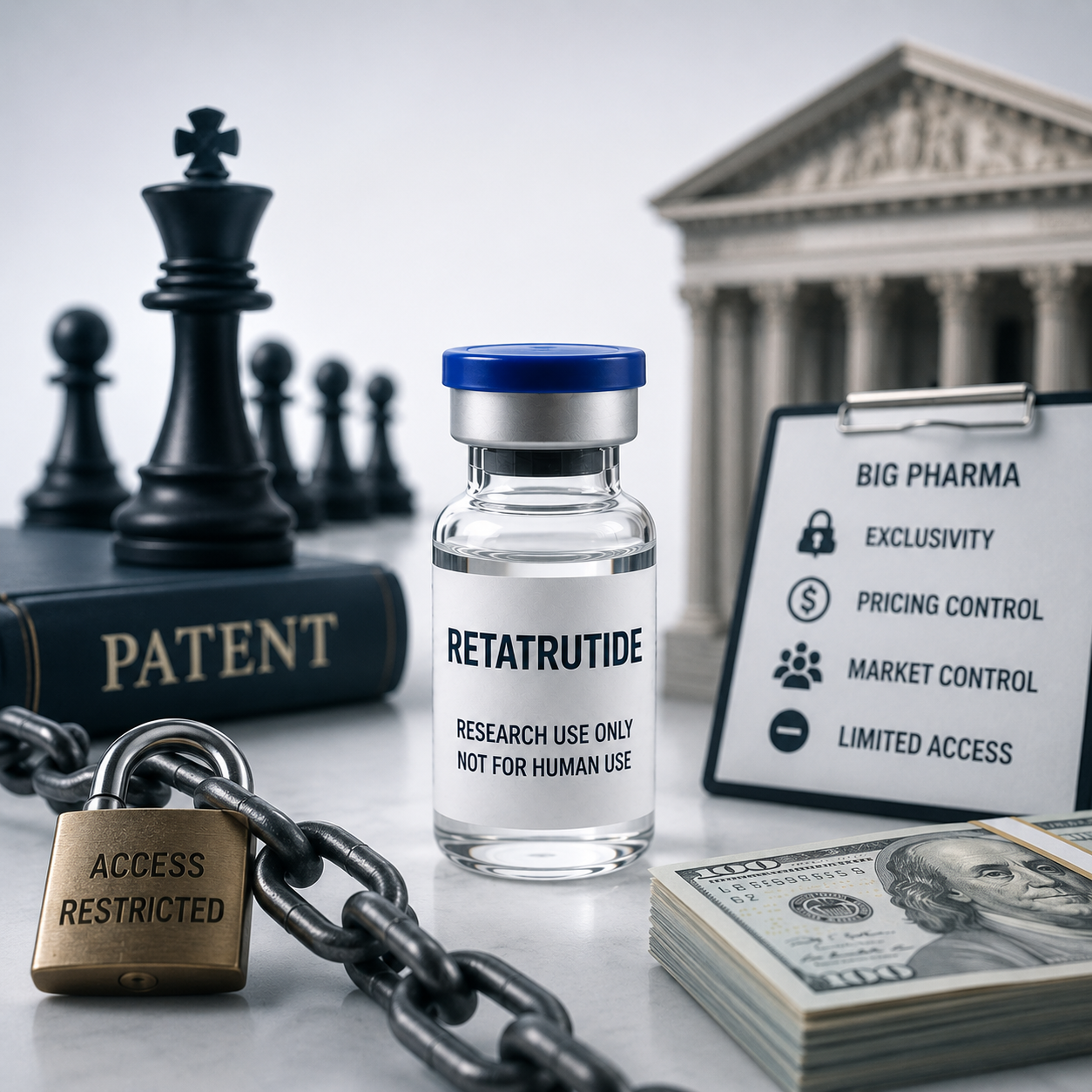
Lilly is escalating its fight against unauthorized retatrutide sales. But the controversy raises a broader question: how should society balance patient safety, scientific innovation, affordability and access to promising medicines?
Lilly Is Escalating Its Fight Over Retatrutide
On August 12, 2026, Eli Lilly announced a major escalation in its efforts to stop unauthorized sales of retatrutide, its investigational triple-hormone receptor agonist.
The company announced six new lawsuits against U.S. entities and called on social-media platforms, e-commerce companies, payment processors, credit-card companies and shipping providers to help stop unauthorized retatrutide sales.
Lilly's position is straightforward: retatrutide remains an investigational medicine, and products being sold outside its clinical-development program have not been verified by Lilly for identity, quality, safety or efficacy.
That safety concern deserves to be taken seriously.
But this story also raises a much bigger question.
When a pharmaceutical company develops an extraordinarily promising molecule, where should we draw the line between protecting patients and controlling access to that molecule?
First, What Is Retatrutide?
Retatrutide is an investigational molecule developed by Lilly that activates three metabolic hormone receptors:
GIP + GLP-1 + glucagon
That makes it different from medications targeting fewer metabolic pathways.
And the clinical results have attracted enormous attention.
In Lilly's Phase 3 TRIUMPH-1 trial, participants receiving the 12 mg dose lost an average of 28.3% of their body weight at 80 weeks under one of the trial's statistical estimands.
Additional Phase 3 results reported in July 2026 showed substantial weight and A1C improvements among participants with obesity or overweight and type 2 diabetes.
Another Phase 3 study, TRIUMPH-4, reported significant improvements in both body weight and knee osteoarthritis pain.
Those are meaningful findings.
But they do not mean retatrutide is currently an approved medication.
Retatrutide Is Still Investigational
This distinction matters.
As of August 2026, retatrutide has not been approved by the FDA or another regulatory authority for consumer use, according to Lilly.
Clinical trials exist precisely because researchers still need to establish the appropriate balance of efficacy, adverse effects, dosing, contraindications and longer-term safety.
One major Phase 3 cardiovascular study, TRIUMPH-3, enrolled nearly 2,000 participants with obesity or overweight and established cardiovascular disease.
So there is legitimate scientific work still being done.
And this is where the debate becomes more complicated.
The Safety Argument Is Real
There is an important point that shouldn't be ignored simply because it comes from a pharmaceutical company.
If somebody purchases a vial online labeled “retatrutide,” the label itself does not prove what's actually inside it.
Questions remain:
Is it actually retatrutide?
Does the amount match the label?
What impurities are present?
Was the product manufactured under appropriate controls?
Was sterility evaluated?
Was endotoxin testing performed?
A chromatographic purity percentage alone cannot answer all of those questions.
The FDA likewise warns that unapproved versions of GLP-1-related drugs do not undergo the agency's premarket review for safety, effectiveness and quality.
Those aren't imaginary concerns.
But Access Is a Legitimate Conversation Too
Acknowledging those risks shouldn't end the discussion.
The pharmaceutical industry exists within an unusual intersection of science, intellectual property, regulation, healthcare and enormous commercial incentives.
Developing a medicine through large clinical programs is extraordinarily complex and expensive. Companies understandably seek intellectual-property protection and regulatory exclusivity to recover investments and finance future research.
At the same time, patients and consumers have legitimate concerns about:
Affordability
Insurance coverage
Availability
Pricing
Access to new therapies
How much control a single manufacturer should have over a medically important molecule
Those issues shouldn't automatically be dismissed simply because unauthorized products can present genuine safety concerns.
Both conversations can exist simultaneously.
Protection or Control? The Important Distinction
Calling every corporate enforcement action a monopoly would oversimplify what's happening.
But accepting every restriction under the banner of “patient safety” without asking questions would oversimplify it too.
The better questions are:
How much control should innovators receive?
Companies need incentives to spend billions developing and testing new medicines.
But society also benefits when important medical innovations eventually become broadly accessible.
What happens when demand arrives before approval?
Retatrutide presents an unusual example.
Public interest became enormous while the molecule was still undergoing clinical development.
That creates a gap between demand and legitimate commercial availability.
Markets tend to respond to gaps.
Unfortunately, an unauthorized market can include everything from sophisticated analytical suppliers to mislabeled, contaminated or completely fraudulent products.
Those differences matter.
Will eventual access be affordable?
We don't yet know what an eventual commercial retatrutide product would cost because retatrutide has not been approved or commercially launched.
Therefore, claims that Lilly is currently restricting retatrutide specifically to maintain a particular future price would be speculation.
But asking what affordable access will look like if the medicine is approved is completely reasonable.
Research Products and Medicines Shouldn't Be Confused
Another important distinction is often lost in online discussions.
A compound sold for legitimate laboratory research is not automatically equivalent to an FDA-approved pharmaceutical product.
Likewise, putting “research use only” on a vial doesn't transform an unauthorized consumer drug sale into legitimate laboratory research.
Intended use matters.
A research material should be represented accurately for research—not marketed through claims about personal weight loss, dosing, treatment or medical outcomes.
That distinction protects both researchers and consumers.
What Should Matter Most: Transparency
Regardless of which side of the pharmaceutical-access debate someone takes, there is one principle that should be difficult to argue against:
Transparency.
Researchers should know:
what material they're obtaining,
which batch they're receiving,
what analytical testing was performed,
what the testing actually demonstrates,
what the testing does not demonstrate,
and whether the compound is approved or investigational.
Consumers deserve transparency too.
They should understand when a molecule remains investigational rather than assuming that online popularity means regulatory approval.
##
Retatrutide is only one example of a much larger tension in modern medicine.
We want pharmaceutical companies to invest heavily in discovering new molecules.
We want rigorous clinical trials.
We want regulators to identify unsafe medicines.
We want manufacturers held accountable for quality.
But we also want successful medical innovations to eventually become accessible to the people who may benefit from them.
Those goals aren't mutually exclusive.
The challenge is building a system that rewards genuine innovation without allowing affordability and access to become secondary considerations.
Our Perspective at C₂ Tides
At C₂ Tides, we believe scientific discussions are strongest when they acknowledge complexity rather than choosing whichever side is most convenient.
Lilly has legitimate reasons to be concerned about products represented as retatrutide being sold directly to consumers without regulatory approval or verified manufacturing controls.
At the same time, the enormous public interest surrounding retatrutide demonstrates something important:
People care deeply about access to emerging metabolic research and future therapeutic innovation.
As retatrutide moves through clinical development, the conversation shouldn't only be about who controls the molecule.
It should also be about quality, transparency, evidence, affordability and responsible access.
Those questions will become even more important if retatrutide eventually receives regulatory approval.
The Bottom Line
Lilly's latest enforcement effort represents an important moment in the development of retatrutide.
https://investor.lilly.com/news-releases/news-release-details/lilly-calls-online-platforms-payment-companies-and-regulators?utm_source=chatgpt.com
The company views unauthorized retatrutide sales as a serious patient-safety problem and is now asking not only regulators but technology companies, financial institutions and logistics providers to intervene.
Those safety concerns deserve attention.
So do the larger questions surrounding pharmaceutical competition, pricing and access.
The most productive conversation isn't simply:
“Big Pharma bad.”
or
“Anything outside Big Pharma is unsafe.”
The better question is:
How do we protect scientific innovation and patient safety while ensuring that important medical advances ultimately remain accessible?
That's a debate worth having.
Educational commentary only. Retatrutide remains investigational and is not FDA-approved. This article does not recommend purchasing, administering or using investigational research compounds.
Sources
Lilly — August 12 retatrutide announcement
Lilly — Phase 3 TRIUMPH-1 resultsLilly — Phase 3 TRIUMPH-2 results
FDA — Concerns with unapproved GLP-1 drugs