
By C² Tides
Peptides vs. Proteins: What’s the Difference?
Peptides and proteins are both built from amino acids, but they differ in size, structure, folding, and biological complexity. This beginner-friendly guide explains where peptides end and proteins begin and why the distinction is not always as simple as it sounds.
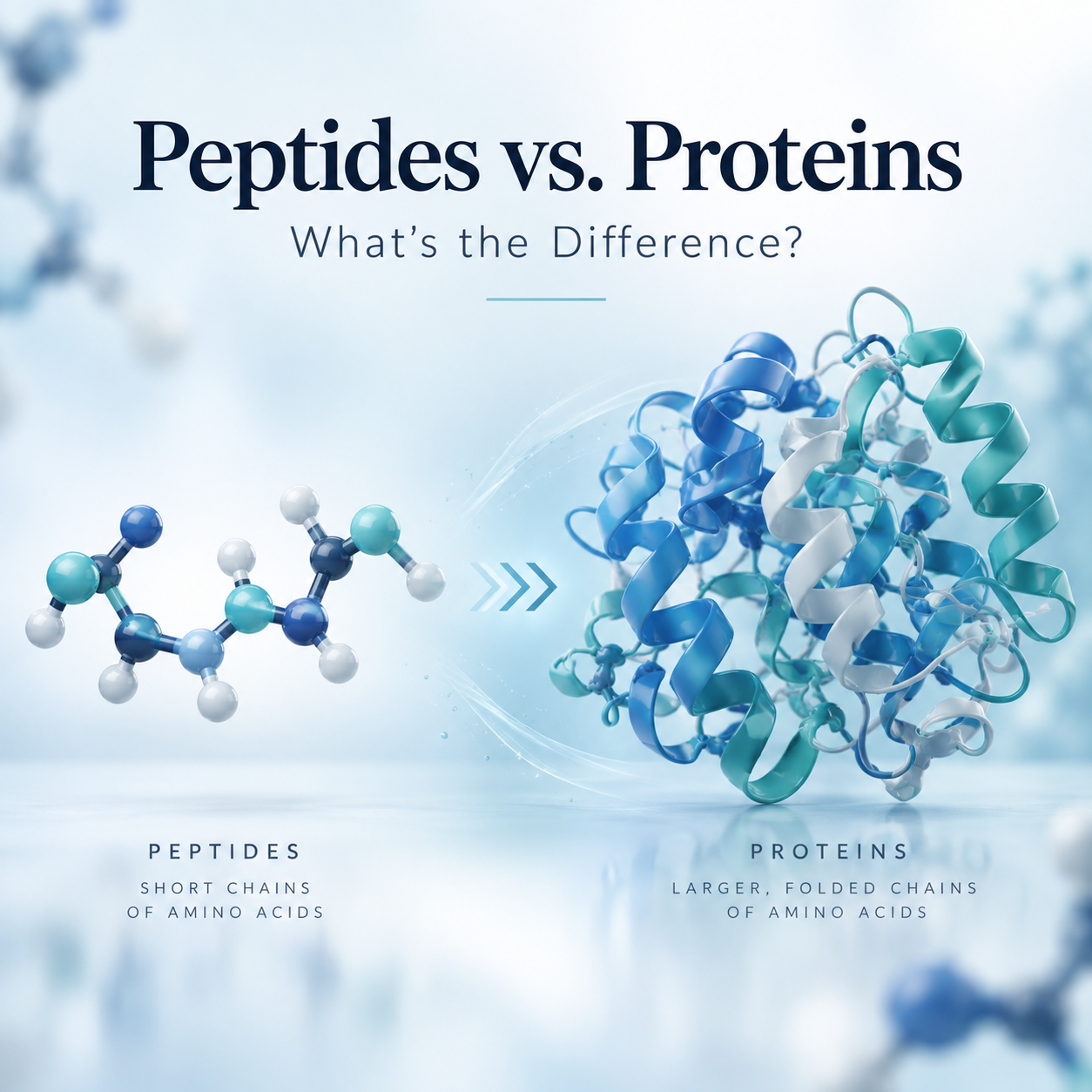
Peptides vs. Proteins: What’s the Difference?
Peptides and proteins are often discussed as if they are completely different types of molecules.
In reality, they are closely related.
Both are built from the same basic building blocks:
Amino acids.
The main differences usually involve:
- Chain length
- Molecular size
- Three-dimensional structure
- Biological complexity
- How the molecule behaves in the body
- How scientists classify and study it
The simplest way to think about it is:
Peptides are generally shorter chains of amino acids, while proteins are usually larger, more structurally complex chains of amino acids.
But the science is a little more interesting than that.
Start With Amino Acids
Amino acids are the fundamental building blocks used to create peptides and proteins.
Each amino acid contains a common chemical backbone along with a variable structure known as a side chain or R group.
That side chain gives each amino acid its unique chemical properties.
Some amino acids interact strongly with water.
Others tend to avoid water.
Some carry electrical charges.
Others can form bonds that help stabilize complex molecular structures.
These differences become extremely important once many amino acids are connected together.
The order of amino acids in a chain can influence how the molecule folds, which molecules it interacts with, and what biological function it may perform.
What Is a Peptide Bond?
Amino acids become connected through chemical linkages called peptide bonds.
A peptide bond forms between the amino group of one amino acid and the carboxyl group of another.
Once amino acids begin linking together, they can form:
- Dipeptides
- Tripeptides
- Oligopeptides
- Polypeptides
- Proteins
The names generally reflect the size and complexity of the amino-acid chain.
The National Library of Medicine describes peptides as compounds made from amino acids connected by peptide bonds.
That same basic chemistry is also what builds proteins.
So chemically speaking, peptides and proteins belong to the same broader family of molecules.
What Is a Peptide?
A peptide is generally considered a relatively short chain of amino acids joined by peptide bonds.
Different scientific sources use slightly different size definitions.
One commonly used educational definition describes peptides as chains containing approximately 2 to 50 amino acids.
Other classification systems divide them further.
For example:
- Dipeptide: 2 amino acids
- Tripeptide: 3 amino acids
- Oligopeptide: a relatively small number of amino acids
- Polypeptide: a longer amino-acid chain
There is no single universal number at which every scientist agrees a peptide suddenly becomes a protein.
That is one reason the terminology sometimes overlaps.
What Is a Protein?
Proteins are also made from amino acids connected through peptide bonds.
What generally distinguishes proteins is their greater size and their ability to form complex three-dimensional structures.
Proteins can contain:
- Dozens of amino acids
- Hundreds of amino acids
- Thousands of amino acids
Once a protein is produced, the amino-acid chain can fold into a highly specific shape.
That shape is often essential to its biological function.
Proteins can act as:
- Enzymes
- Receptors
- Structural components
- Transport molecules
- Antibodies
- Signaling molecules
- Ion channels
- Cellular machinery
The National Institute of General Medical Sciences explains that protein function depends heavily on both amino-acid sequence and three-dimensional shape.
In other words:
A protein is not just a long string of amino acids. Its folding and structure often determine what it can actually do.
So Where Is the Line Between a Peptide and a Protein?
This is where things become less straightforward.
There is no universally accepted scientific cutoff separating peptides from proteins.
Some textbooks and educational resources use approximately 40 or 50 amino acids as a convenient dividing line.
However, classification depends partly on context.
Scientists may consider:
- Number of amino acids
- Molecular weight
- Folding behavior
- Biological function
- Structural complexity
- Regulatory definitions
This means two molecules of similar length might sometimes be discussed differently depending on their structure and biological role.
The FDA Uses a Specific Regulatory Definition
Scientific terminology and regulatory terminology are not always identical.
For certain regulatory purposes, the U.S. Food and Drug Administration defines a protein as an alpha-amino-acid polymer with a specific defined sequence that contains more than 40 amino acids.
Under that framework, an amino-acid polymer containing 40 or fewer amino acids may be considered a peptide.
This regulatory distinction can matter when determining how certain pharmaceutical products are classified.
However, this should not be mistaken for a universal biological law.
The 40-amino-acid threshold is useful for regulation.
Biochemistry itself is more nuanced.
Size Is Only Part of the Difference
It is tempting to think:
Short = peptide
and
Long = protein
But length alone does not tell the entire story.
Proteins typically develop more complicated levels of structure.
Scientists commonly describe protein structure in four levels.
Primary Structure
Primary structure is simply the amino-acid sequence.
For example:
Amino acid 1 → amino acid 2 → amino acid 3 → amino acid 4
The exact order matters.
Changing even one amino acid can sometimes alter how the entire molecule behaves.
Peptides also have primary structures.
Secondary Structure
As amino-acid chains become longer, sections of the chain can begin forming repeating structural patterns.
Two common examples are:
- Alpha helices
- Beta sheets
These shapes are stabilized by interactions within the peptide backbone.
Tertiary Structure
Tertiary structure refers to the overall three-dimensional folding of a single polypeptide chain.
Different amino-acid side chains interact with one another, causing the molecule to fold into a specific shape.
That shape often determines the molecule's function.
Quaternary Structure
Some proteins contain multiple separate polypeptide chains that assemble together.
Their combined structure is called quaternary structure.
This level of organization is much more commonly associated with proteins than with short peptides.
Insulin Shows Why the Terminology Can Get Complicated
Insulin is a useful example.
Human insulin contains two amino-acid chains:
- One chain with 21 amino acids
- One chain with 30 amino acids
Those chains are connected by disulfide bonds.
Despite its relatively small size, insulin is commonly described as a protein hormone.
This shows why chain length by itself does not always determine everyday scientific terminology.
Structure, function, and historical convention can all matter.
Peptides Often Function as Signals
Many naturally occurring peptides act as biological messengers.
They can participate in processes involving:
- Hormonal signaling
- Immune communication
- Nervous-system signaling
- Appetite regulation
- Metabolism
- Tissue responses
- Cellular communication
Because peptides are relatively small, they can sometimes interact very specifically with receptors.
A peptide may bind to a receptor on the surface of a cell and trigger a signaling pathway inside that cell.
This does not mean every peptide works the same way.
Different peptides can have completely different biological roles depending on their sequence and structure.
Proteins Can Perform Much Larger Jobs
Proteins often perform more structurally demanding or mechanically complex functions.
Examples include:
Enzymes
Enzymes accelerate chemical reactions.
Many cellular reactions would occur far too slowly without them.
Receptors
Receptor proteins recognize signaling molecules and help transmit information into cells.
Structural Proteins
Proteins such as collagen provide strength and organization to tissues.
Transport Proteins
Some proteins carry substances through blood or across cell membranes.
Antibodies
Antibodies are complex proteins that recognize specific molecular targets as part of immune defense.
Because proteins can form elaborate three-dimensional structures, they can perform extremely specialized biological tasks.
Peptides Can Also Have Complex Structures
It is important not to oversimplify peptides.
Shorter molecules can still have sophisticated chemical features.
Peptides may be:
- Linear
- Cyclic
- Branched
- Modified with fatty-acid chains
- Linked to other chemical groups
- Stabilized through special bonds
Researchers can also chemically modify peptides to change properties such as:
- Stability
- Solubility
- Receptor binding
- Resistance to enzymatic breakdown
- Duration of activity
This is one reason modern peptide research has become such a significant area of pharmaceutical science.
Natural Peptides vs. Synthetic Peptides
Peptides can occur naturally inside living organisms.
They can also be produced synthetically in laboratories.
Natural peptides may be produced through biological processes inside cells.
Synthetic peptides are assembled chemically using controlled laboratory methods.
The amino-acid sequence can be identical or similar to naturally occurring peptides, depending on the research goal.
Synthetic chemistry also allows researchers to create modified peptides that do not occur naturally.
These modifications may help scientists study:
- Receptor interactions
- Molecular stability
- Structure-function relationships
- Metabolism
- Pharmacology
Molecular Weight Usually Increases With Chain Length
Another useful difference between peptides and proteins is molecular size.
Each amino acid adds mass to the chain.
Short peptides typically have relatively low molecular weights.
Large proteins may have molecular weights measured in kilodaltons, abbreviated kDa.
One kilodalton equals approximately 1,000 daltons.
However, molecular weight and amino-acid count are related but not identical measurements.
Different amino acids have different molecular masses, and chemical modifications can also change the final molecular weight.
Why Smaller Molecules Can Behave Differently
Peptides and proteins can differ in:
- Stability
- Folding
- Solubility
- Absorption
- Enzymatic breakdown
- Cellular transport
- Receptor interactions
Short peptides may be more flexible and structurally simple.
Larger proteins can form extensive folded structures with specialized binding regions.
These differences influence how researchers analyze and characterize them.
How Peptides and Proteins Are Studied
Researchers use many analytical techniques to investigate peptides and proteins.
Common approaches include:
- High-performance liquid chromatography
- Mass spectrometry
- Amino-acid analysis
- Peptide mapping
- Sequencing
- Spectroscopy
- Electrophoresis
- Structural analysis
Mass spectrometry is especially useful for measuring molecular mass and helping confirm molecular identity.
Chromatographic techniques can help researchers evaluate purity and separate different components within a sample.
Larger proteins may require additional methods to understand their folding and higher-order structure.
Sequence Matters More Than Just Length
Imagine two peptides containing exactly 15 amino acids.
They may have the same length but completely different sequences.
As a result, they could have entirely different:
- Shapes
- Charges
- Binding properties
- Biological targets
- Functions
This is why simply knowing how many amino acids a peptide contains does not tell you what it does.
Sequence determines identity.
Structure then influences function.
The same principle applies to proteins.
Why Peptides Are Interesting in Research
Peptides occupy an interesting middle ground in molecular biology.
They are larger and more structurally informative than individual amino acids but often smaller and less complex than full proteins.
This can make them useful research tools for studying:
- Receptors
- Signaling pathways
- Hormonal systems
- Tissue responses
- Cellular communication
- Protein interactions
Peptides can also serve as fragments or functional regions of larger proteins.
Researchers sometimes study smaller peptide sequences to understand which portions of a protein are responsible for a particular biological interaction.
Are All Peptides Parts of Proteins?
No.
Some peptides are produced independently as signaling molecules.
Others may be generated when larger proteins are broken down.
Some synthetic peptides are designed specifically for laboratory research.
So while peptides and proteins share the same chemical building blocks, peptides are not simply unfinished proteins.
They can have important biological roles on their own.
Are All Proteins Made From Peptides?
Proteins are built from amino acids linked through peptide bonds.
For this reason, a protein chain can technically be described as a polypeptide chain.
Some proteins contain one polypeptide chain.
Others contain multiple chains assembled together.
So the relationship can be thought of like this:
Amino acids → peptide chains → polypeptides → complex proteins
But the boundaries between these categories are not perfectly rigid.
Peptide vs. Protein: A Simple Comparison
Peptides
Generally:
- Shorter amino-acid chains
- Lower molecular weight
- Less extensive three-dimensional folding
- Often involved in signaling
- Can be naturally occurring or synthetic
- May contain chemical modifications
Proteins
Generally:
- Longer amino-acid chains
- Larger molecular size
- More extensive folding
- More complex three-dimensional structure
- Often perform structural, enzymatic, transport, immune, or receptor functions
- May contain multiple polypeptide chains
These are useful generalizations rather than absolute rules.
Why the Difference Matters in Research
Understanding whether a molecule is considered a peptide or protein can influence:
- Analytical testing
- Manufacturing
- Stability studies
- Storage requirements
- Regulatory classification
- Structural characterization
- Research design
For example, a small peptide may be characterized primarily through techniques such as chromatography and mass spectrometry.
A large protein may require additional analysis to confirm:
- Folding
- Aggregation
- Quaternary structure
- Biological activity
- Structural integrity
The more complicated the molecule becomes, the more complicated its analytical characterization may become as well.
The Regulatory Definition Can Matter Too
The difference between a peptide and protein can sometimes become legally important.
FDA's regulatory definition of protein has played a role in determining whether certain pharmaceutical products fall under conventional drug pathways or biological-product pathways.
That may influence:
- Application type
- Manufacturing requirements
- Regulatory oversight
- Competition
- Biosimilar pathways
This is another reminder that scientific classification and regulatory classification are related but not always identical.
The Simplest Way to Remember It
If you remember only one concept from this article, remember this:
Peptides and proteins are made from the same building blocks.
Both consist of amino acids connected by peptide bonds.
The main difference is generally one of:
size + structure + complexity.
Peptides tend to be smaller.
Proteins tend to be larger and more extensively folded.
But there is no perfect biological line separating the two.
Context matters.
The Bottom Line
Peptides and proteins are closely related molecules built from amino acids connected through peptide bonds.
Peptides are generally shorter chains and often function as signaling or regulatory molecules.
Proteins are typically larger and can fold into complex three-dimensional structures that allow them to function as enzymes, receptors, antibodies, transporters, and structural components.
However:
There is no single universal scientific number where a peptide automatically becomes a protein.
Different sources use different conventions.
For regulatory purposes, FDA currently defines a protein as an alpha-amino-acid polymer with a specific defined sequence containing more than 40 amino acids.
That regulatory threshold is useful, but biology remains more nuanced.
The most accurate way to think about the relationship is:
Peptides and proteins exist along the same molecular spectrum.
They share the same building blocks.
What changes is the size of the chain, how it folds, how complex the final structure becomes, and what biological function that structure allows it to perform.
Sources & Further Reading
National Library of Medicine — Peptides
The NLM defines peptides as amino-acid compounds linked through peptide bonds and describes proteins as larger versions capable of forming complex structures.
NCBI Bookshelf — Biochemistry, Peptide
An educational overview of peptide structure, peptide bonds, amino-acid chains, and peptide classification.
National Institute of General Medical Sciences — The Power of Proteins
An overview of amino acids, protein folding, structure, and biological function.
U.S. Food and Drug Administration — Peptides, Proteins and Regulatory Science
FDA explains its regulatory definition of a protein as an amino-acid polymer containing more than 40 amino acids.
Educational and Research Use Only
This article is provided for educational and laboratory research purposes only.
It is intended to explain basic concepts involving amino acids, peptides, proteins, molecular structure, and scientific classification.
Nothing in this article constitutes medical advice or recommends the purchase, administration, or human or veterinary use of any research material.