
· Updated
By C² Tides
Peptide Purity vs. Identity: Why “99% Pure” Doesn’t Tell the Whole Story
A peptide COA may report 99%+ purity, but purity and identity are not the same measurement. Learn what HPLC, mass spectrometry, batch-specific testing, and analytical methods actually tell researchers about a sample.
Peptide Purity vs. Identity: Why “99% Pure” Doesn’t Tell the Whole Story
A Certificate of Analysis shows 99.5% purity.
At first glance, that number sounds like it tells you almost everything you need to know about a peptide sample.
But there is an important question that often gets overlooked:
Does a high purity percentage actually prove that the material is the compound listed on the label?
Not necessarily.
Purity and identity are related concepts, but they answer different analytical questions.
Understanding the difference between them is one of the most important parts of interpreting peptide testing correctly.
Purity and Identity Are Not the Same Thing
In analytical testing, purity generally asks:
How much of the detected sample consists of the main component compared with detectable impurities or related substances?
Identity asks something different:
Is the main component actually the molecule it is claimed to be?
These are not interchangeable questions.
A sample can appear highly pure by one analytical method while still requiring additional testing to confirm what the primary compound actually is.
That is why professional analytical strategies often rely on multiple complementary tests rather than one number on a report.
FDA guidance reflects this principle.
Identification testing should be specific enough to distinguish the intended compound from closely related structures, and FDA specifically notes that relying only on a single chromatographic retention time is generally not considered sufficiently specific for identification.
What Does “99% Pure” Usually Mean?
When researchers see a purity value such as:
98.7%
99.1%
or
99.8%
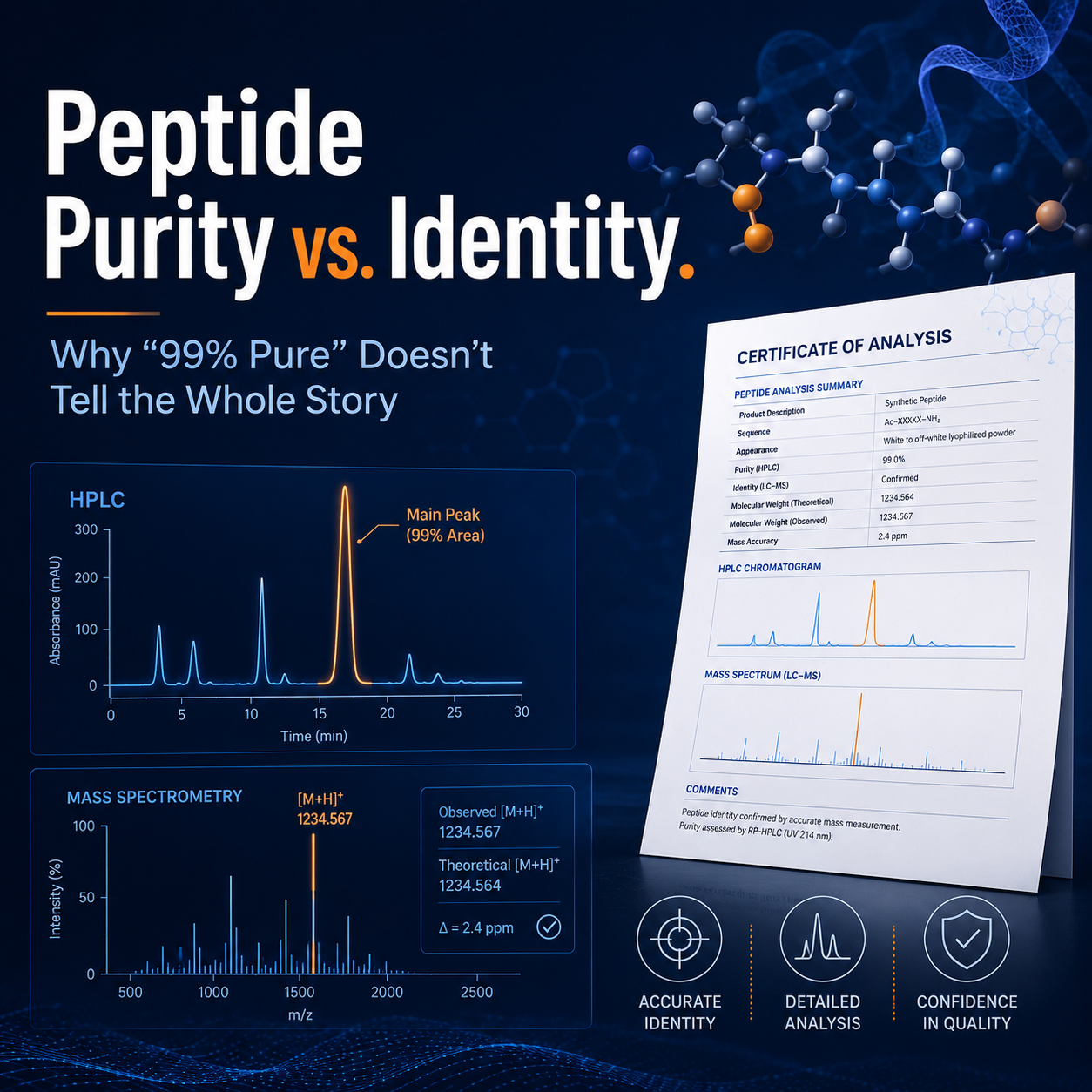
that number is often generated using a chromatographic method such as HPLC, or High-Performance Liquid Chromatography.
HPLC separates components of a sample as they move through a chromatographic column.
Different compounds interact with the column and mobile phase differently, causing them to appear at different retention times.
The resulting chromatogram contains peaks representing detectable components within the sample.
The largest peak is often associated with the intended analyte.
The relative peak area may then be used to calculate a reported purity percentage.
For example:
- Main peak: 99.2%
- Other detectable peaks: 0.8%
The report may therefore describe the sample as approximately 99.2% pure under the conditions of that analytical method.
But that still leaves another question:
What is the main peak?
That is where identity testing becomes important.
What HPLC Is Good At
HPLC is an extremely useful analytical technique.
It can help researchers examine:
- Relative purity
- Impurity profiles
- Degradation products
- Batch consistency
- Separation of related compounds
- Changes in a sample over time
For peptide research, chromatographic analysis can provide valuable information about how cleanly a primary component separates from other detectable materials.
FDA has long described HPLC as a technique used to characterize or determine purity by separating components as they pass through a chromatographic column.
But HPLC does not automatically provide complete structural identification.
A peak appearing at the expected retention time can support identification, especially when compared against a qualified reference standard.
However, FDA guidance specifically cautions that identification based only on one chromatographic retention time is generally not sufficiently specific.
That is why chromatographic data is often combined with another analytical technique.
What Identity Testing Tries to Answer
Identity testing asks:
Is this actually the molecule we think it is?
For peptides, that can involve analytical techniques such as:
- Mass spectrometry
- High-resolution mass spectrometry
- Peptide mapping
- Amino acid analysis
- Sequencing methods
- Reference-standard comparison
- Spectroscopic techniques
Depending on the peptide and research context, laboratories may use one or more of these methods.
The purpose is to confirm characteristics associated with the expected molecular structure.
Why Mass Spectrometry Matters
Mass spectrometry is one of the most important analytical tools used in peptide characterization.
At a basic level, mass spectrometry measures the mass-to-charge ratio of ionized molecules.
For peptide analysis, this allows researchers to compare the measured molecular mass with the expected molecular mass of the target compound.
If the expected peptide should have a particular molecular weight and the measured sample produces data consistent with that value, that provides important supporting evidence for identity.
Mass spectrometry can also help researchers identify:
- Molecular variants
- Peptide-related impurities
- Structural modifications
- Degradation products
- Differences between expected and observed masses
FDA materials describe mass spectrometry as useful for primary structural analysis of peptides and small proteins and for identifying variants in peptide composition.
HPLC and Mass Spectrometry Answer Different Questions
This is the easiest way to understand the difference.
HPLC
Primarily helps answer:
How clean is the sample under this chromatographic method?
Mass Spectrometry
Helps answer:
Does the molecular mass or structure match what we expect the compound to be?
Using both provides substantially more information than using either one in isolation.
A simplified example:
A laboratory tests a sample and reports:
HPLC Purity: 99.4%
That tells us the dominant chromatographic component represents approximately 99.4% of the detected material under that method.
Then mass spectrometry shows a molecular mass consistent with the expected peptide.
Together, those results provide stronger evidence supporting both:
- Purity
- Identity
That is very different from looking only at the purity percentage.
Why a High Purity Number Alone Can Be Misleading
Imagine two hypothetical samples.
Sample A
HPLC shows:
99.5% purity
But no independent identity analysis is provided.
Sample B
HPLC shows:
99.1% purity
Mass spectrometry also confirms a molecular mass consistent with the expected compound.
Which report tells you more?
Sample B may actually provide the more informative analytical package even though its reported purity number is slightly lower.
This illustrates an important concept:
A bigger purity number is not automatically the same thing as better characterization.
Analytical quality depends on what was tested, how it was tested, whether appropriate reference materials were used, and whether the methods were capable of answering the intended question.
What About “99.9% Purity”?
Extremely high purity percentages can look impressive.
But researchers should avoid evaluating a report based solely on whether it says:
99.1%
versus
99.6%
versus
99.9%
Small differences may be influenced by:
- Method conditions
- Integration settings
- Detection thresholds
- Sample preparation
- Instrument sensitivity
- Reference standards
- Impurity separation
- Laboratory methodology
A purity number should be interpreted as part of the complete analytical context, not as a standalone score.
The more useful question is often:
What testing supports this result?
Why Impurity Profiles Matter
Purity testing is not only about the size of the main peak.
Researchers may also be interested in the smaller components present in the sample.
These could include:
- Synthesis-related impurities
- Truncated peptide sequences
- Deletion sequences
- Oxidized forms
- Deamidated forms
- Aggregates
- Residual processing-related materials
- Degradation products
For synthetic peptide products, FDA has specifically emphasized the importance of sensitive analytical methods capable of detecting and characterizing peptide-related impurities.
High-resolution techniques such as UHPLC-HRMS may be used when detailed impurity characterization is necessary.
This is another reason a single purity number cannot describe everything about sample quality.
Identity, Purity, Strength and Quality Are Separate Concepts
Another source of confusion is the tendency to combine several laboratory terms into one idea.
They are not identical.
Identity
Is the material what it claims to be?
Purity
How much of the detected sample consists of the primary component compared with impurities?
Strength or Content
How much of the target compound is actually present?
Quality
A broader concept that may include:
- Identity
- Purity
- Strength
- Stability
- Consistency
- Impurity profile
- Analytical reliability
FDA's analytical guidance treats identity, strength, quality, purity and potency as distinct characteristics that may require appropriate analytical procedures.
That distinction matters when reading any Certificate of Analysis.
Purity Does Not Automatically Tell You How Much Peptide Is in the Vial
This is another common misunderstanding.
Suppose a report says:
99% purity
That does not necessarily mean:
99% of the entire vial's total weight is active peptide.
A lyophilized material may contain other components such as:
- Water
- Residual salts
- Counterions
- Buffers
- Excipients
- Residual solvents
Chromatographic purity and total peptide content are therefore not always the same measurement.
A laboratory may need separate quantitative methods to establish total content or strength.
This is why well-characterized reference standards are important in quantitative peptide analysis.
Reference Standards Matter
Analytical results become more meaningful when a sample can be compared with a properly characterized reference standard.
A reference standard provides a known benchmark.
For peptide testing, reference standards may help support:
- Identity confirmation
- Retention-time comparison
- Quantitation
- Method validation
- System suitability
- Batch comparison
USP research on synthetic peptide reference standards emphasizes the importance of well-characterized standards for determining identity, purity and strength.
Reference standards themselves may be characterized using multiple analytical methods such as:
- NMR
- Mass spectrometry
- Chromatography
- Content analysis
- Stability studies
This illustrates a broader principle:
Reliable analytical conclusions usually come from multiple pieces of evidence working together.
What Does Batch-Specific Testing Mean?
Another important concept is batch-specific documentation.
A Certificate of Analysis is most useful when the tested material can be connected clearly to the actual batch being evaluated.
Researchers should look for information such as:
- Batch or lot identifier
- Sample identifier
- Test date
- Analytical method
- Laboratory information
- Report number
- Result interpretation
Without a clear batch connection, a high-quality laboratory report may still provide limited information about a different sample.
A COA should ideally help answer:
Was this actual batch tested?
rather than simply:
Has a sample with this compound name ever been tested?
Why Third-Party Testing Can Add Value
Third-party testing means analytical work is performed by a laboratory that is separate from the manufacturer or seller whose material is being evaluated.
The value is not simply the phrase “third-party tested.”
What matters is the documentation.
Researchers should consider whether the report provides:
- Clear laboratory identification
- Batch matching
- Analytical methods
- Test dates
- Report identifiers
- Purity results
- Identity evidence where applicable
Transparency matters more than marketing language.
Can One Test Do Everything?
Usually not.
Different analytical methods have different strengths and limitations.
Chromatography may provide excellent separation and impurity information.
Mass spectrometry may provide strong molecular-mass evidence.
NMR may provide structural information.
Content assays may quantify the amount of material present.
Stability testing may evaluate whether characteristics change over time.
This is why analytical science often uses a complementary testing strategy.
FDA guidance also reflects this principle by recommending sufficiently specific identification methods and recognizing combined approaches such as:
- HPLC/MS
- HPLC with diode-array detection
- Multiple chromatographic procedures based on different separation principles
The goal is not simply to produce more data.
The goal is to answer different analytical questions with methods suited to those questions.
How Researchers Should Read a Peptide COA
Instead of immediately looking for the biggest percentage on the page, consider reading a COA in this order:
1. Confirm the Compound Name
Does the report clearly identify the compound being analyzed?
2. Check the Batch or Lot Number
Can the report be connected to the specific batch?
3. Look at the Testing Method
Was the sample tested using:
- HPLC
- LC-MS
- Mass spectrometry
- Another validated analytical procedure?
4. Identify What the Result Actually Represents
Does the reported percentage refer to:
- Chromatographic purity
- Assay content
- Strength
- Something else?
5. Look for Identity Evidence
Does the report include molecular-mass or other identity-confirmation data?
6. Review the Test Date
Analytical documentation should include when the testing was performed.
7. Look at the Laboratory Information
Can the testing laboratory and report be identified?
This approach provides far more useful information than simply asking whether the purity number is above 99%.
Why “Purity” Has Become Such a Powerful Marketing Number
Purity is easy to communicate.
A number like:
99.8%
looks precise, scientific and simple.
But analytical chemistry is rarely that simple.
A single number cannot describe:
- Molecular identity
- Exact peptide content
- Stability
- Every impurity
- Biological activity
- Sterility
- Endotoxin status
- Manufacturing consistency
Those characteristics require separate analytical questions and, in many cases, separate testing.
Researchers should therefore treat purity as one part of a larger evidence package.
What Researchers Should Look for Instead
A stronger evaluation framework asks:
Is the sample identified?
Is purity measured?
Is testing batch-specific?
Are the analytical methods disclosed?
Is the laboratory identifiable?
Are results independently verifiable where appropriate?
Does the documentation clearly distinguish identity, purity and content?
These questions provide a much more complete picture.
Why This Matters for Peptide Research
Research depends on knowing what material is actually being studied.
If identity is uncertain, experimental conclusions become more difficult to interpret.
If impurity levels vary significantly between batches, research reproducibility can suffer.
If documentation cannot be tied to the tested batch, researchers may have less confidence in the analytical record.
For this reason, proper characterization is not just a marketing feature.
It is part of good experimental practice.
FDA research standards similarly emphasize knowing the identity, purity, composition and other characteristics necessary to define each batch of a test or reference substance before use in a study.
Purity vs. Identity: The Simplest Explanation
If you remember only one thing from this article, remember this:
Purity asks how much of the detected sample appears to be the main component.
Identity asks whether that main component is actually the molecule you expected.
You want evidence supporting both.
A high purity result can be useful.
But it becomes much more meaningful when paired with appropriate identity testing, batch-specific documentation and transparent analytical methods.
The Bottom Line
A peptide COA reporting 99%+ purity can provide useful information.
But that number does not tell the entire analytical story.
Purity and identity answer different questions.
HPLC can provide valuable information about chromatographic purity and impurity profiles.
Mass spectrometry and other identity-focused analytical methods can help confirm whether the material matches the expected molecular characteristics.
Batch-specific documentation can help connect those results to the actual sample being evaluated.
Reference standards, validated analytical procedures and complementary testing methods can further strengthen confidence in the results.
The goal should therefore not be to chase the highest purity percentage.
The better goal is:
Understand exactly what was tested, what each method measured, and what the complete analytical package actually demonstrates.
That is a much stronger foundation for research than any single number.
Sources & Further Reading
U.S. Food and Drug Administration — Q6A Specifications: Test Procedures and Acceptance Criteria
FDA discusses identification, assay and analytical specificity, including why a single chromatographic retention time alone may not provide sufficiently specific identification.
U.S. Food and Drug Administration — Analytical Procedures and Methods Validation for Drugs and Biologics
FDA guidance addressing analytical procedures used to document identity, strength, quality, purity and potency.
U.S. Food and Drug Administration — Guidance for Industry: Synthetic Peptides
FDA discusses analytical characterization of synthetic peptides and the importance of sensitive procedures for detecting peptide-related impurities.
Read the FDA synthetic peptide guidance
United States Pharmacopeia — Reference Standards to Support Quality of Synthetic Peptide Therapeutics
Research describing analytical approaches used to establish peptide identity, purity, strength and reference-standard quality.
Educational and Research Use Only
This article is provided for educational and laboratory research purposes only.
It is intended to explain general analytical concepts involving peptide identity, purity, chromatography, mass spectrometry and Certificates of Analysis.
Nothing in this article constitutes medical advice, nor does it recommend the purchase, administration or human or veterinary use of any research material.
Analytical results should be interpreted in the context of the specific laboratory method, sample, reference standard and testing conditions used.